Transformation depends on retrievable reasons
Thesis: ERP and finance transformations depend on knowledge distributed across people, routines, systems, records and narratives; when the reasons behind process and design decisions cannot be retrieved, organizations repeat analysis, recreate workarounds and lose the ability to improve coherently.
Transformation programmes generate large volumes of documentation. Yet a procedure can describe what to do without preserving why a control exists, which alternatives were rejected, what evidence changed a design or when an exception should be revisited. When project members leave, the file remains but the decision becomes difficult to reconstruct.
Organizational memory is an established academic concept. Norquantia does not claim ownership of the term. Foundational research examines how organizations acquire, retain and retrieve information, and how memory can be used, misused or abused [1]. Norquantia’s contribution here is a management interpretation for ERP and finance transformation: connect decision rationale to operating ownership and retrieval, while creating a controlled route for obsolete knowledge to be retired.
Definitions for memory, learning and forgetting
- Organizational memory
- Information from an organization’s history that can be brought to bear on present decisions, retained across multiple organizational locations [1].
- Organizational learning
- A process through which experience is interpreted and encoded into knowledge, routines or changed behavior; it is related to memory but is not identical to storage [2] [3].
- Organizational forgetting
- Loss or displacement of organizational knowledge, which can be accidental or purposeful and can have harmful or beneficial effects [4].
- Institutional amnesia
- A sustained inability to recall and use relevant past knowledge. Research cited here examines government settings, so its mechanisms must not be assumed to generalize automatically to every company [5] [6].
- Explicit knowledge
- Knowledge expressed in records, models, procedures, decisions or other forms that can be inspected and transferred.
- Tacit knowledge
- Situated know-how that is difficult to fully articulate and may be embedded in practice, judgement and relationships.
- Decision rationale
- The problem, evidence, constraints, alternatives and authority that explain why a decision was made.
- Knowledge retention
- The placement and maintenance of knowledge in locations where it can persist.
- Knowledge retrieval
- The ability to find, interpret and apply retained knowledge in a relevant new context.
- Controlled unlearning
- A governed decision to retire an obsolete assumption, routine or control while preserving enough rationale to explain the change.
Knowledge management describes practices and systems for handling knowledge. It can support organizational memory, but a repository or taxonomy does not prove that people can retrieve the right rationale when a decision is being made.
Where ERP and finance knowledge resides
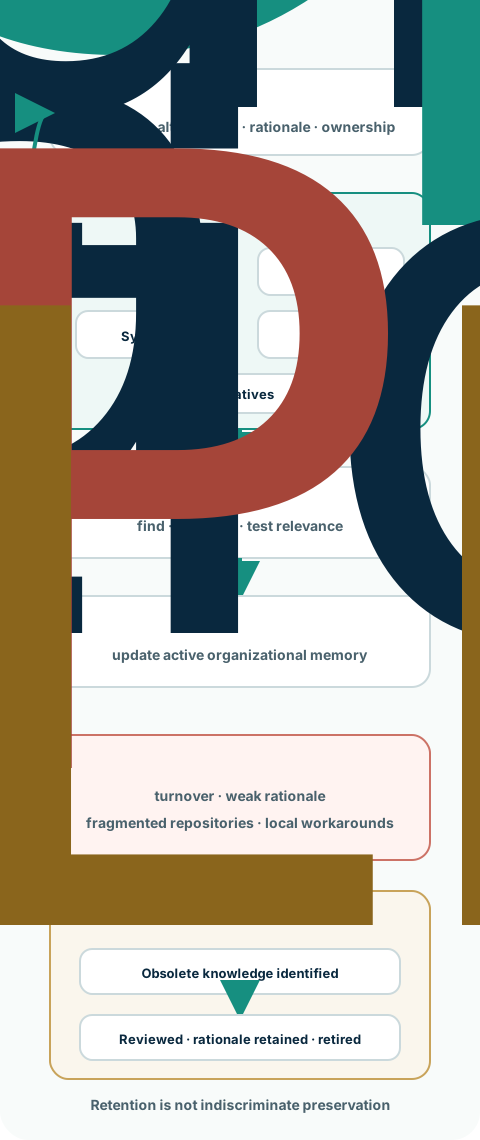
ERP knowledge is distributed. People remember workshop trade-offs and local constraints. Routines encode the sequence and ownership of work. Systems embody configured rules, fields and interfaces. Records preserve approvals, models and test evidence. Narratives explain what the organization believes happened and why.
Walsh and Ungson’s established framework identifies multiple retention locations and emphasizes acquisition, retention and retrieval [1]. This article does not reproduce that model. It applies the broader insight that memory is distributed: a transformation team should not treat the document library as the only place where knowledge exists.
Why document repositories are insufficient
A repository can hold complete files and still fail the management need. Search terms may not match later questions. Final documents may omit rejected options. Access may be restricted to a dissolved project group. The procedure may have been updated without linking to the decision that changed it. Most importantly, retrieval often occurs under time pressure when the person does not know that a relevant record exists.
Useful memory therefore requires context and ownership. A decision record should name the question, evidence, alternatives, constraints, owner, date and review condition. It should link to the process, control or configuration affected. Someone must remain responsible for its currency and for deciding whether it still applies.
How transformation knowledge is lost
Knowledge can disappear through turnover, role changes, fragmented repositories, vendor transitions, weak handover and local workarounds. It can also remain technically present but become inaccessible because terminology changed or the rationale was never recorded. Organizational forgetting research distinguishes different dynamics rather than treating every loss as the same failure [4].
Public-sector studies describe mechanisms including organizational churn, absorptive capacity, strategic use of memory and historical storytelling [5]. These mechanisms are useful prompts, not proof that a private finance function behaves identically. Leaders should test which mechanisms appear in their context.
Illustrative scenario
A procedure that remembers what, but not why
This composite example is illustrative and is not based on a named client. During an ERP implementation, finance and operations design an intercompany process. Workshops resolve a difficult trade-off between central consistency and local timing. The final procedure records the approved steps, but not the rejected options, underlying data limitation or condition for revisiting the control.
Two project members leave. A local team encounters a volume increase and creates a spreadsheet workaround. Because the rationale is absent, the team believes the central procedure is arbitrary. A later transformation team sees inconsistent reporting and repeats much of the original analysis. It proposes a new configuration that conflicts with another entity’s reporting logic.
Management can preserve every historical document, or create a smaller governed memory path. The organization reconstructs a decision record from workshop notes, configuration evidence and interviews. A process owner validates the current rationale, links it to the control and sets a review trigger. The workaround is classified: one element addresses a real capacity constraint and is redesigned; another duplicates a control and is deliberately retired.
The intervention preserves enough history to avoid repeating the same analysis, but it does not freeze the original design. Obsolete assumptions are reviewed and retired with an explanation. Future teams can retrieve both the current decision and the path that replaced the old one. The management lesson is that continuity depends on retrievable rationale and controlled unlearning, not indefinite accumulation.
A transformation memory cycle
The operating costs of memory loss
Memory loss can increase analysis effort, but the larger cost is inconsistent decision-making. Teams may recreate controls without understanding their purpose, preserve workarounds after the original constraint disappears, or change reporting logic in one entity without seeing the group dependency. The resulting process debt is difficult to diagnose because each local decision appears reasonable in isolation.
Memory also affects accountability. When rationale and ownership are absent, a decision can appear inevitable even though alternatives existed. Retrievable evidence allows current leaders to challenge the past without misrepresenting it.
When forgetting can be beneficial
Not all memory should be preserved as active guidance. Old controls can reflect systems that no longer exist. Historical workarounds can constrain better design. Narratives can protect a decision after its evidence has expired. De Holan and Phillips examine purposeful and accidental forgetting as distinct dynamics [4], while Stark’s later public-sector analysis explicitly asks when some amnesia may support renewal [6].
Controlled unlearning provides a management response. The organization identifies the knowledge proposed for retirement, assesses dependencies, names an owner, records why it is obsolete and updates the active process. The old rationale remains as history but no longer governs current action. This is different from deleting records or allowing knowledge to fade unnoticed.
The NTS Learn stage
The public Norquantia Transformation System™ lifecycle ends with Learn and loops back into renewed discovery, assessment and design. Learn is not a closing retrospective stored beside project archives. It should change how the organization frames the next decision.
Experience becomes useful when context and outcomes are examined, retained in appropriate locations and retrieved at later gates. Argote and Miron-Spektor describe organizational experience interacting with context to create knowledge [3]. The management implication is that learning needs both operational feedback and a route into decision governance.
Organizational Memory Analysis
The Organizational Memory Analysis assessment family can examine where critical transformation knowledge resides, which decisions lack rationale, how ownership changes affect retrieval and where obsolete routines remain active. It is not a certification or a claim that all knowledge can be formalized.
A proportionate output might include a decision-record map, retention-location risks, retrieval tests for selected decisions, ownership gaps and recommendations for controlled retirement. The question is not “Have all documents been stored?” but “Can the organization retrieve the evidence and reasoning required for this decision?”
Founder perspective
Magnus Ove’s perspective
Magnus Ove’s view is that transformation teams often document outputs more effectively than decision rationale. The organization may remember what was configured while forgetting why the process, control or ownership model was chosen.
Management questions for transformation memory
- Which decisions would be difficult to reconstruct if two key people left?
- Where does the rationale live: people, routines, systems, records or narratives?
- Can a new owner find the evidence without already knowing the project history?
- Which workarounds encode a legitimate requirement, and which preserve an expired constraint?
- Who decides when a control or assumption should be reviewed?
- How does learning alter a current roadmap, gate or operating decision?
- What should be retired deliberately, and what history must remain to explain that retirement?
Advisory connections
The ERP Process Audit service can surface workarounds, ownership gaps and process rationale that are invisible in configuration inventories. Finance Systems Transformation can connect retained knowledge to target-state decisions and controlled change. These services apply the public NTS lifecycle; they do not claim ownership of the academic concept of organizational memory.
References
- James P. Walsh and Gerardo Rivera Ungson (1991), “Organizational Memory,” Academy of Management Review, 16(1), 57–91. https://doi.org/10.5465/amr.1991.4278992
- Barbara Levitt and James G. March (1988), “Organizational Learning,” Annual Review of Sociology, 14, 319–338. https://doi.org/10.1146/annurev.so.14.080188.001535
- Linda Argote and Ella Miron-Spektor (2011), “Organizational Learning: From Experience to Knowledge,” Organization Science, 22(5), 1123–1137. https://doi.org/10.1287/orsc.1100.0621
- Pablo Martin de Holan and Nelson Phillips (2004), “Remembrance of Things Past? The Dynamics of Organizational Forgetting,” Management Science, 50(11), 1603–1613. https://doi.org/10.1287/mnsc.1040.0273
- Alastair Stark (2019), “Explaining institutional amnesia in government,” Governance, 32(1), 143–158. https://doi.org/10.1111/gove.12364
- Alastair Stark (2024), “Institutional Amnesia in Government: How much is enough?” Policy Quarterly, 20(1), 3–9. https://doi.org/10.26686/pq.v20i1.9046
Norquantia distinguishes established research findings from its own management interpretation. Public-sector findings are used to illuminate possible mechanisms, not treated as automatically generalizable to every company. The conceptual model and practical scenario are Norquantia syntheses.