Go-live changes the operating question
Thesis: go-live is a technical and operational transition point, not evidence that benefits have been realized or that new ways of working have become organizational capability.
An ERP programme can complete data migration, cut over integrations and open the production environment on schedule. Those achievements matter. They show that the organization has crossed a difficult delivery threshold. They do not, by themselves, show that process owners can govern the new model, that teams have stopped using parallel spreadsheets, that reporting definitions are shared or that expected benefits are appearing in operations.
The management question therefore changes at go-live. Before cutover, leaders ask whether the system and organization are ready to enter operation. After cutover, they must ask whether the operating model is stable, adopted, owned and improving. Research on post-implementation ERP activity supports treating this period as a distinct management domain rather than the residual tail of a project [1] [2] [3] [4].
Definitions that prevent false closure
- Go-live
- The authorized transition of an ERP configuration, data set and connected operating processes into production use.
- Implementation completion
- Closure of an agreed delivery scope against defined acceptance criteria. It is a project judgement, not a universal measure of transformation success.
- Stabilization
- The controlled period in which defects, data issues, operational bottlenecks and support demand are brought within tolerable limits.
- Adoption
- Consistent use of the intended process, roles and controls in real work—not attendance at training or possession of system access.
- Benefit realization
- The governed process of testing whether intended operational, control or decision benefits are occurring, for whom, under what conditions and with what evidence.
- Optimization
- Deliberate improvement of process, configuration, controls, data and capability after a stable baseline exists.
- Organizational capability
- A repeatable ability distributed across people, routines, decision rights, information and technology rather than concentrated in a temporary project team.
- Post-implementation review
- A structured examination of implementation choices, realized outcomes, misfits, learning and required changes after the system enters use [1].
No single definition of “success” fits every programme. Availability, close-cycle performance, control quality, user proficiency, decision speed and benefit evidence answer different questions. Management should name the question and its evidence rather than compressing them into one status colour.
Why project plans overemphasize implementation
Project governance naturally concentrates attention on milestones that are visible before go-live: configuration, migration rehearsals, test completion, training delivery and cutover readiness. Budgets and supplier scopes are often organized around those deliverables. A production date provides a clear coordination target, while adoption and benefit realization unfold unevenly across roles, entities and processes.
This asymmetry can create false closure. A steering committee may interpret delivery acceptance as the moment when ownership can disperse. Yet the new operating environment is precisely when previously hidden design assumptions meet transaction volume, local variation and real decision pressure. The work has changed form; it has not disappeared.
Technical deployment is not organizational transformation
Technical deployment answers whether the configured system can operate. Organizational transformation asks whether people can use it coherently, controls work in context, ownership is active and the organization can respond when assumptions prove incomplete. A system can be technically available while the operating model remains fragmented.
This distinction avoids blaming users for every workaround. A workaround may reflect habit, but it may also signal an unresolved policy, missing data, ambiguous responsibility or a process that the design never represented. Leaders need evidence before deciding whether to remove, redesign or temporarily govern it.
What post-implementation ERP research contributes
Nicolaou’s qualitative work defines post-implementation review quality as more than the presence of a review meeting. It examines project planning, design principles, misfit resolution, attained benefits and organizational learning [1]. Later work by Nicolaou and Bhattacharya finds that the nature and timing of post-implementation activities matter and cautions that no change or timing is universally effective [2].
Hietala and Päivärinta’s case study shows why benefits realization must continue into post-implementation development: evolved processes, workarounds and different subsidiary needs can obstruct continued value, while unused solutions can persist when benefits are not actively governed [3]. Zhu and colleagues, studying the Chinese retail industry, distinguish implementation quality and organizational readiness as important contributors to post-implementation success in that context [4]. These studies do not establish one universal recipe. Together, they support a narrower conclusion: post-go-live outcomes depend on continuing organizational choices, not merely the existence of an operational ERP.
The NTS lifecycle after Implement
The public Norquantia Transformation System™ uses a connected lifecycle: Discover → Assess → Design → Implement → Adopt → Optimize → Learn ↺. Go-live usually occurs within or near the transition out of Implement. It does not erase the remaining stages.
Adopt tests whether intended behaviors, roles and controls are working. Optimize uses an operating baseline to prioritize improvements rather than collecting an ungoverned wish list. Learn preserves decision rationale and feeds evidence back into renewed discovery, assessment and design. The loop matters because post-go-live evidence may invalidate earlier assumptions. Governance must permit a decision to correct the model, not merely defend the project plan.
Illustrative scenario
A successful cutover with an unfinished operating model
This composite example is illustrative and is not based on a named client. A multi-entity finance organization deploys a new ERP. Technical cutover succeeds: invoices and journals can be processed, opening balances reconcile within agreed tolerances and the production support queue is active.
During the first close, local teams continue parallel spreadsheets because reporting definitions differ by entity. Training attendance was high, but proficiency is uneven: some users know the sequence of screens without understanding the control intent. Process ownership is unclear, so the project team resolves policy questions that should belong to operations. Leaders assume that standardization and faster reporting will follow, but no owner has defined the evidence or review cadence for those benefits.
Management initially faces a choice: close the programme as delivered, or establish a time-bounded post-go-live governance phase. Closing releases resources sooner, but leaves local decisions to accumulate. The organization instead names global and local process owners, separates defects from policy decisions and improvement requests, defines shared reporting terms, and measures proficiency through observed work rather than attendance.
A post-implementation review identifies three different interventions. One spreadsheet is retired because the ERP report meets the agreed need. A second remains temporarily under control while a data dependency is corrected. A third exposes a legitimate local requirement and becomes a governed design decision. The consequence is not instant uniformity. It is a traceable path from evidence to ownership, adoption and improvement. The management lesson is that post-go-live governance should classify what the organization is seeing before demanding conformity or approving customization.
Go-live as a gateway
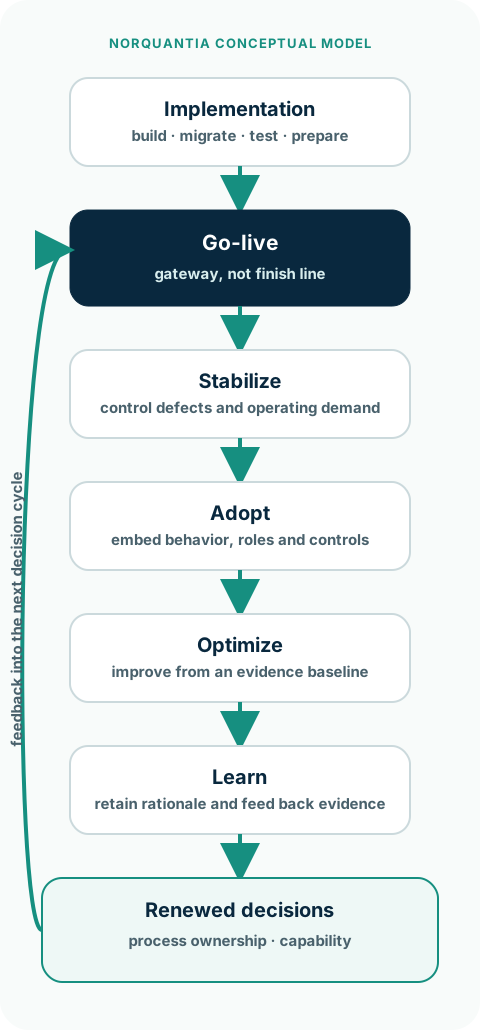
Governance and ownership after go-live
Post-go-live governance needs fewer project rituals and clearer operating decisions. Each issue should have a classification, evidence, owner and decision date. Defects, access incidents, data-quality problems, process-policy questions, adoption gaps and enhancement requests have different routes. Combining them in one backlog hides authority.
Business process owners must be able to decide process intent; technology owners must protect architecture and service integrity; control owners must evaluate risk; local leaders must surface legitimate variation. A temporary stabilization forum can coordinate those roles, but it should also define when responsibility transfers into durable operating governance.
Adoption is not the same as training
Training creates an opportunity to learn. Adoption is demonstrated in work. Attendance, course completion and user access are weak proxies if people still cannot resolve exceptions, explain controls or complete the process without unapproved side systems. Useful adoption evidence can include observed task proficiency, exception patterns, support demand, control performance and whether named owners make decisions without relying on the former project team.
Optimization and learning require a baseline
Optimization should not begin as unrestricted configuration change. First establish a stable baseline: which process is intended, what outcome matters, which constraints apply and who owns the decision. Then compare improvement options against evidence and dependencies. Learning closes the loop by recording not only what changed, but why, what evidence supported it and when the rationale should be reviewed.
This is also where benefit realization becomes credible. Leaders can compare intended benefits with operating evidence, identify who experiences the benefit or burden, and decide whether to adjust process, capability, data or technology. A benefit that cannot be observed or owned should remain a hypothesis rather than a reported success.
Founder perspective
Magnus Ove’s perspective
Magnus Ove’s view is that a technically successful cutover should be treated as the beginning of a new operating phase. Ownership, adoption, process discipline and learning determine whether the system becomes an organizational capability.
Management questions before declaring transformation complete
- Which claims are technical acceptance statements, and which are benefit claims?
- Who owns each end-to-end process after the project structure closes?
- What evidence distinguishes training attendance from working proficiency?
- How are defects, local requirements, workarounds and improvement ideas classified?
- Which benefits have measures, baselines, owners and review dates?
- What decision rationale must remain retrievable for the next change cycle?
- What conditions allow stabilization governance to end without creating an ownership gap?
Assessment and advisory connections
An ERP Assessment or ERP Process Assessment can establish the post-go-live baseline without presuming that every variance is a system problem. The ERP Process Audit service examines process, data, controls and ownership in operation. Finance Systems Transformation connects those findings to a governed change path, while Independent ERP Advisory supports decisions that should not be driven by vendor momentum.
References
- Andreas I. Nicolaou (2004), “Quality of postimplementation review for enterprise resource planning systems,” International Journal of Accounting Information Systems, 5(1), 25–49. https://doi.org/10.1016/j.accinf.2004.02.002
- Andreas I. Nicolaou and Somnath Bhattacharya (2008), “Sustainability of ERPS performance outcomes: The role of post-implementation review quality,” International Journal of Accounting Information Systems, 9(1), 43–60. https://doi.org/10.1016/j.accinf.2007.07.003
- Heidi Hietala and Tero Päivärinta (2021), “Benefits Realisation in Post-Implementation Development of ERP Systems: A Case Study,” Procedia Computer Science, 181, 419–426. https://doi.org/10.1016/j.procs.2021.01.186
- Yan Zhu, Yan Li, Weiquan Wang and Jian Chen (2010), “What leads to post-implementation success of ERP? An empirical study of the Chinese retail industry,” International Journal of Information Management, 30(3), 265–276. https://doi.org/10.1016/j.ijinfomgt.2009.09.007
Norquantia distinguishes established research findings from its own management interpretation. The conceptual model and practical scenario are Norquantia syntheses.